
Installation of ventilation systems
Installation is one of the key stages in the implementation and arrangement of a ventilation system. And high-quality installation is impossible without the coordinated work of qualified specialists. The company “Termal” is ready to provide equipment and materials only from proven brands, as well as professional workers for installation and service.
The installation of a ventilation system consists of a set of works for which a project is required in advance. Only the project can ensure the competent installation of the system. The project will allow you to coordinate work with related organizations and determine the exact cost of the work.
Realized projects
-
Residential complexes, Apartments
HVAC system of the Lion Hills residential complex

-
Warehouses, Office centers
HVAC system of the office and warehouse complex of Suzirya LLC

-
Apartments
HVAC system of the penthouse

-
Restaurants and cafes
HVAC system of the Tbilisuri restaurant

-
Restaurants and cafes, Shopping centers and stores
HVAC system for the Garage gastro-hub by Goodwine

-
Office centers, Restaurants and cafes, Coworking spaces
HVAC system of coworking space “Generator”

-
Private houses
HVAC system for a 600 m² private house

-
Gas stations
HVAC system of the KLO filling stations network

-
Restaurants and cafes
HVAC system of the Belkin restaurant

-
Warehouses, Office centers
HVAC system of the office and warehouse complex of LLC “STS-Co”


Our clients





















Types of ventilation equipment
The main component of the ventilation system is the ventilation unit. It is accompanied by sound attenuators, a network of air ducts, air valves and distribution devices, depending on the system.
First, let’s look at the types of equipment. The installations include:
- household exhaust fans
- monoblock supply and exhaust and supply and exhaust units
- complete air handling units, supply and exhaust units
Our company offers a wide range of equipment and components for ventilation systems.
Installation of household ventilation
For domestic ventilation, exhaust fans of small diameter are mainly used. Most often, they are used to remove air from bathrooms, showers and bathrooms, dressing rooms, and utility rooms. Such fans additionally remove excess moisture, unpleasant odors and steam.
This system is also equipped with air ducts and a check valve that prevents outside air from entering the room when the fan is off. In most cases, the air is removed through the exhaust shafts to the outside.
Installation of household fans
Household fans are divided according to the direction of air relative to the impeller – into axial and centrifugal, and according to the type of installation – wall and ceiling.
- Before installing the fan, the air outlet holes are prepared and the power supply is connected.
- When installing the fan in a suspended ceiling, the casing is installed. If necessary, a rigid or flexible air duct from the fan to the shaft is attached. If possible, the fan is installed directly into the shaft. Then the electric motor is mounted in the already installed housing and a decorative panel is added at the end. Then the fan is started.
- The power connection of the fans may differ depending on the functions required. For example, simply turning on the fan with a key, setting a delay timer, a humidity sensor, or turning on the fan together with the lighting.
Installation of industrial and commercial ventilation
The installation of industrial and commercial ventilation is much more complicated than domestic ventilation. Unlike the latter, such a system cannot be installed without qualified specialists. This significantly increases the capacity and air consumption of the system, requires more time for installation, which also increases the cost of work. Depending on the purpose of the facility, additional obstacles to air treatment may be added, such as explosion hazard.
Ventilation units for large volume rooms
For larger rooms, monoblock and packaged supply and exhaust, supply and exhaust units are used. The only difference between monoblock and packaged units is that in the first case, the components are combined in one housing. The choice between this or that unit depends on the specific facility.
Installation of supply and exhaust and air handling units
The installation of a supply and exhaust system is an order of magnitude more complicated than an exhaust system. They have a larger number of additional equipment and materials. The content includes heaters, coolers, evaporators, dehumidifiers, filters (they are not always needed for exhaust ventilation), sensors and automation for components. The scope of work for the installation of more complex equipment is also greater than for exhaust equipment.
The work of the installation team is organized by the foreman. He also measures and calculates the required number of air ducts and fittings, predicts the time frame for completing the work, and makes decisions regarding changes that occurred during the installation process.
Stages of installation
Installation of the ventilation system takes place in stages:
- Before starting work, they inspect the premises and structures, prepare openings for ventilation ducts and space for the main equipment. Make markings for air ducts and distribution devices (grilles and diffusers) according to the project.
- Mount a monoblock installation or connect a node of elements for a set. The kit also includes sound attenuators and flexible inserts. In some cases, additional installation equipment may be required, such as a construction crane. When installing water heaters, additional work is carried out to assemble and install the heat supply unit and connect it to the heating network.
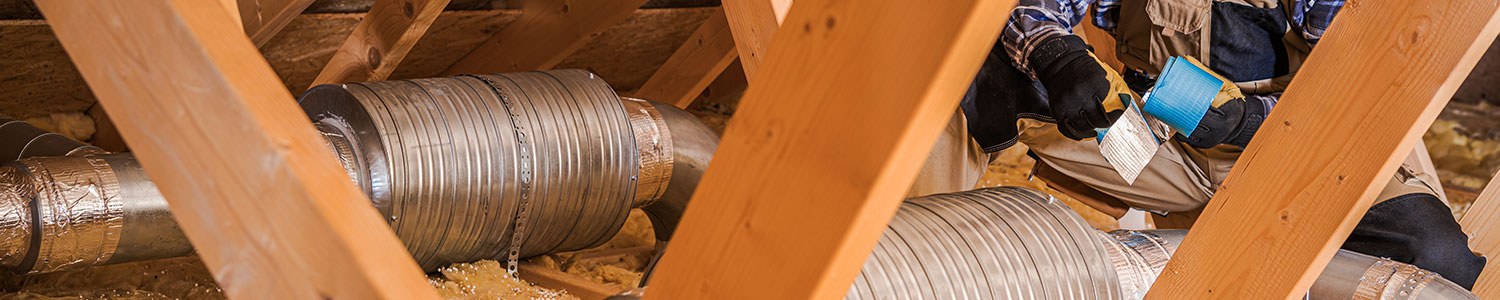
- Next, the air ducts and fittings are assembled, insulated or painted if necessary. A metal bracket is mounted on the ceiling. Air ducts are suspended on it: round – using a clamp or perforated tape, rectangular – using a profile or a traverse with a stud. Vertical installation of the air duct is also carried out. Together with the air ducts, throttle valves are installed to regulate air flow in the future and fire dampers. If necessary, flexible air ducts and plenum boxes for grilles are installed. Then all connections are checked and sealed. Depending on the height of the premises, lifts may be required.
- On average, it takes two weeks to manufacture air ducts. The equipment, if available, is installed first. In other cases, it is installed after delivery, during which other elements of the system are installed.
- If the ventilation unit is located indoors, ducts for air intake and exhaust to the street are installed, along with external grilles.
- Connect drainage pipes if the system is supply and exhaust, as well as for the cooler, evaporator and dehumidifier.
- Install switchgear after finishing work.
- Install and connect automation and dispatching panels with sensors, drives and controllers to manage the system.
- They make a trial run, carry out commissioning and test the system.
- After checking the system, a passport, executive documentation, and acts of completion are prepared.
In addition, our company provides a 1-year warranty on all work performed. The warranty on the equipment depends on the manufacturer.
The cost of installing a ventilation system
The cost of installing a ventilation system depends primarily on the amount of work and equipment capacity, as well as the urgency of the work. Additional services and factors increase the total price, for example, dismantling, drilling holes (this type of work can be performed by other organizations), the presence of high-altitude work; some architectural features of the room that limit the options for installing the ventilation system.
Answers to frequently asked questions